

One-Way Mode nets your exposure: buy while short and you reduce the short. Hedge Mode keeps long and short as separate positions in the same contract, each with its own entry, PnL and liquidation level. The setting looks like a UI preference. It is not — it changes what your orders do, how your margin is consumed, and whether a “flat” book is actually flat.
The most expensive misunderstanding in this area is the belief that an offsetting hedge removes risk. It does not, and the reason is funding.
One-Way Mode: a single net position
In One-Way Mode you hold one position per contract, long or short, and every order adjusts that single position.
Long 2 BTC and sell 1 BTC, and you are long 1 BTC. Sell 3 BTC and you are short 1 BTC — the order closed the long and opened a short in one action.
One position, one entry price, one liquidation level, one PnL figure. For directional trading this is almost always the right setting. It is simpler to reason about, it uses margin efficiently because there is only ever one position to margin, and it makes the question “what am I actually exposed to” trivial to answer.
The limitation: you cannot be long and short the same contract simultaneously. Any attempt to do so nets out.
Hedge Mode: two positions, one contract
In Hedge Mode, long and short positions in the same contract coexist. Each has its own entry price, its own unrealised PnL and its own liquidation reference. Orders must specify which side they apply to.
Long 2 BTC and sell 1 BTC, and you now hold a 2 BTC long and a 1 BTC short — not a 1 BTC net long. Net market exposure is 1 BTC, but you are carrying two positions, two sets of margin obligations and two funding exposures.
That distinction is the whole article.
The setting is available from the gear (‘settings’) icon in the top right corner of the trading page on web.
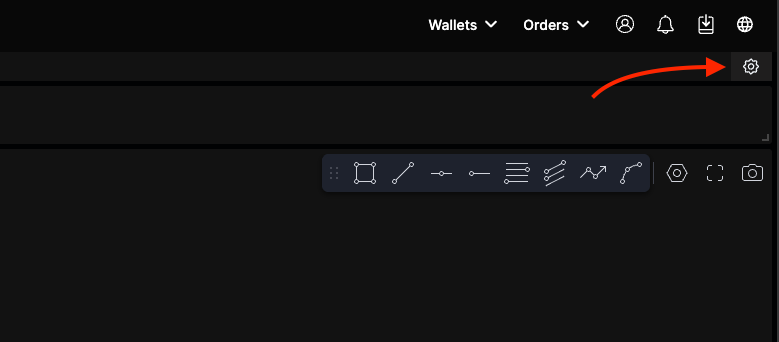
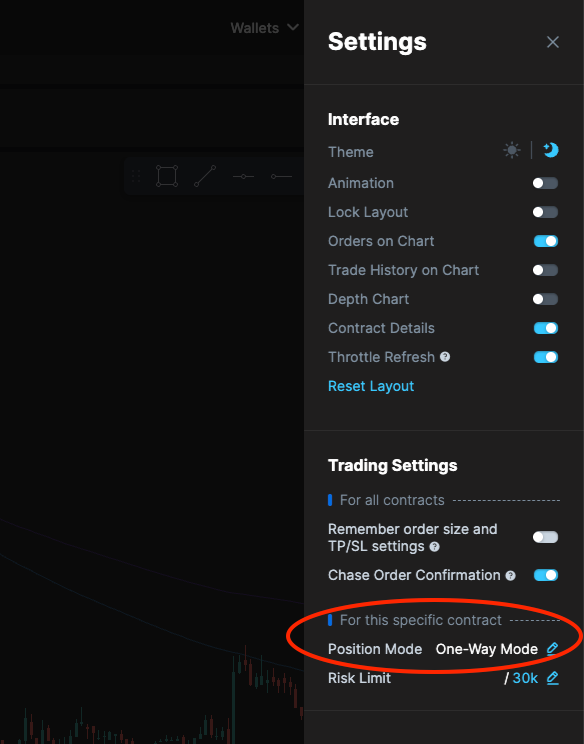
The position mode cannot be changed while positions are open.
Both modes are available for all contracts.
When Hedge Mode earns its complexity
Holding a core position while trading around it. You are long BTC as a multi-month view. A short-term setup suggests downside. In One-Way Mode, shorting reduces your core long, and you lose the entry price you have been holding. In Hedge Mode, the short sits alongside the core long, which is untouched.
Strategies that legitimately need both sides. Basis trades, some grid approaches, and systematic strategies that treat long and short books separately.
Event hedging. Reducing directional exposure through a known event without closing a position you intend to keep afterwards.
Separate accounting. If two strategies run on the same contract and you need their performance tracked independently, Hedge Mode gives you that separation natively.
The three things that go wrong
1. Hedging does not stop the clock
This is the big one.
An equal long and short in the same perpetual contract has roughly zero net market exposure. It does not have zero cost.
Funding keeps accruing on both legs. Funding is charged on notional, by side. Holding both sides means paying funding on one and receiving it on the other. If the rates were perfectly symmetrical these would cancel — but you are paying and receiving at the same rate on the same notional, and the net is not reliably zero once the position is marked against the funding rate’s sign and magnitude over time.
In a sustained positive-funding regime, a hedged book is not free. It is a position with no directional upside and a running cost.
Fees were paid twice. You paid to open both legs and you will pay to close both.
The consequence traders find surprising: a fully hedged position can still be liquidated. Market exposure is flat, but funding and fees draw down equity, and equity falling below maintenance margin is what triggers liquidation. “Flat” is not the same as “safe”.
2. Margin is not free
Two positions generally consume more margin than one net position of the same exposure. The capital efficiency you lose is the price of keeping the positions separate.
3. Order side confusion
In Hedge Mode every order needs a side. A sell order intended to close a long can instead open a short if the wrong side is specified — leaving you with more exposure than before, in the opposite direction to the one you wanted.
This is a routine source of expensive mistakes, particularly for traders switching from One-Way Mode and operating on muscle memory, and particularly on mobile.
Which should you use?
Use One-Way Mode if you trade directionally, you want the simplest possible relationship between orders and exposure, you are new to futures, or capital efficiency matters more to you than position separation. This covers most traders most of the time.
Use Hedge Mode if you maintain a core position you trade around, you run strategies requiring simultaneous sides, or you need separate accounting — and you have understood the funding cost.
Default to One-Way. Hedge Mode should be a decision with a reason behind it, not a setting you enabled once and forgot.
Hedge Mode for API and bot traders
Position mode is part of your API integration, not just a UI setting. Orders must carry position side information when the account is in Hedge Mode, and an integration written against One-Way Mode will behave incorrectly if the account is switched.
CCXT handles this through a position mode parameter. Any strategy intended to run in Hedge Mode needs to set it explicitly and handle both sides in its position reconciliation — a bot that reads “net position” and finds two positions will mis-size its next order.
Frequently asked questions
Can I hold a long and a short on the same contract at the same time? In Hedge Mode, yes. In One-Way Mode, no — the orders net.
Does hedging eliminate my risk? No. It can flatten directional exposure, but funding accrues on both legs, fees were paid on both, and equity drawn down by those costs can still breach maintenance margin.
Can a fully hedged position be liquidated? Yes, through funding and fee drawdown.
Which mode is better for beginners? One-Way Mode. Fewer ways to end up with exposure you did not intend.
Can I switch modes with positions open? No.
Does Hedge Mode cost more? Generally yes, through margin usage and double-sided funding.
Is Hedge Mode available on all contracts? Yes.
